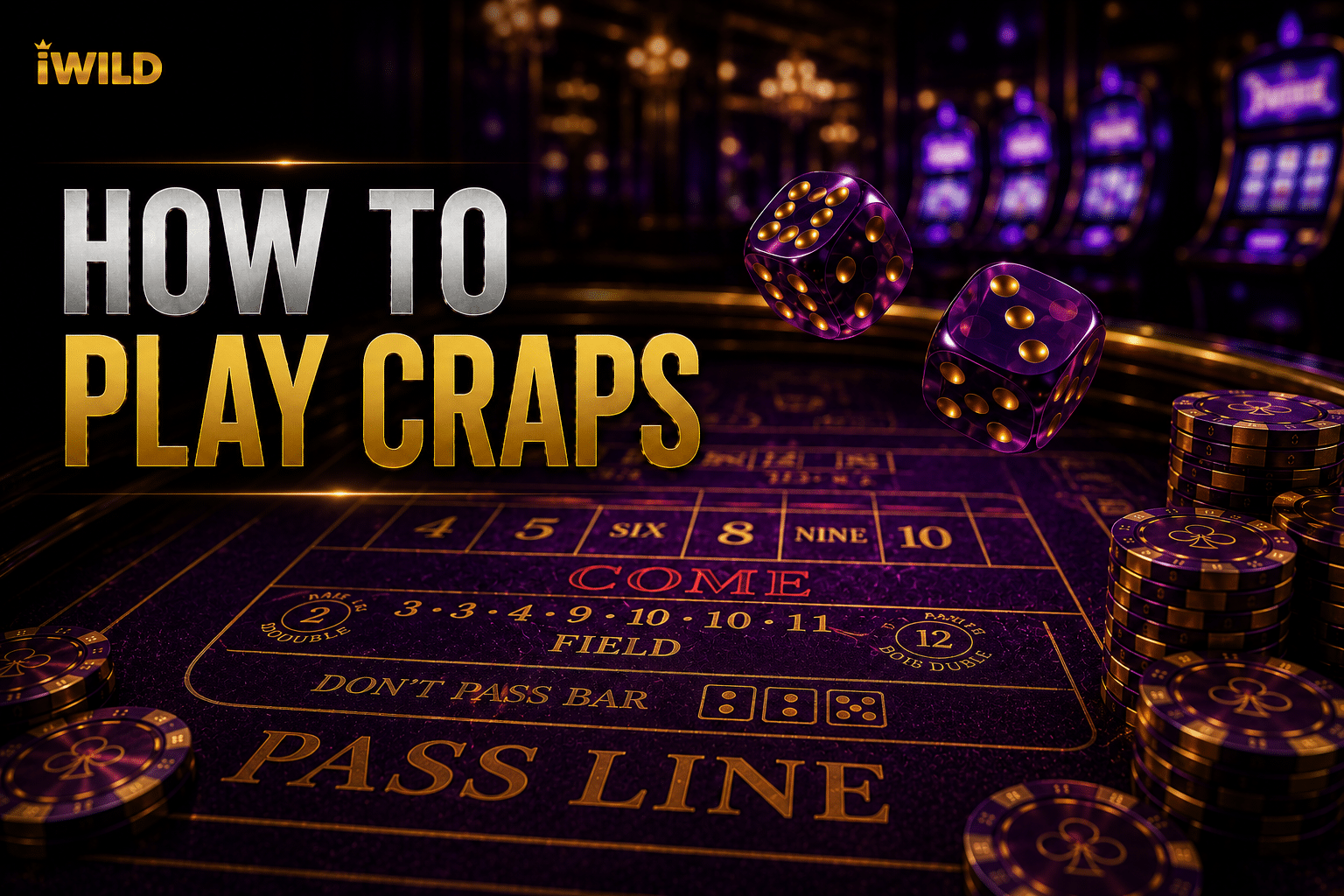
Learning how to play craps feels harder than it is. From outside the table, the game can look like organized chaos, with chips everywhere, rapid dealer calls, and a crowd reacting to every roll. In practice, the action follows one simple cycle: a come-out roll either settles the main bets or establishes a point, then the shooter tries to repeat that point before rolling 7. This guide explains the rules, layout, essential bets, table procedure, and etiquette beginners need.
What Is Craps?
Craps is a casino dice game built around totals produced by two six-sided dice. One player at a time becomes the shooter and rolls for everyone at the table. Most players bet with the shooter through Pass Line and Come wagers, while others bet against the shooter through Don’t Pass and Don’t Come. That shared outcome creates the game’s lively atmosphere, because several people can win or lose from the same throw even when their individual bets differ.
Basic Rules: The Come-Out Roll and the Point
A standard craps decision has two phases: the come-out roll and, when one is established, the point phase. Learn this sequence first. Once you understand what changes when the puck moves from OFF to ON, the table markings, dealer calls, and available wagers become much easier to follow.
The Come-Out Roll
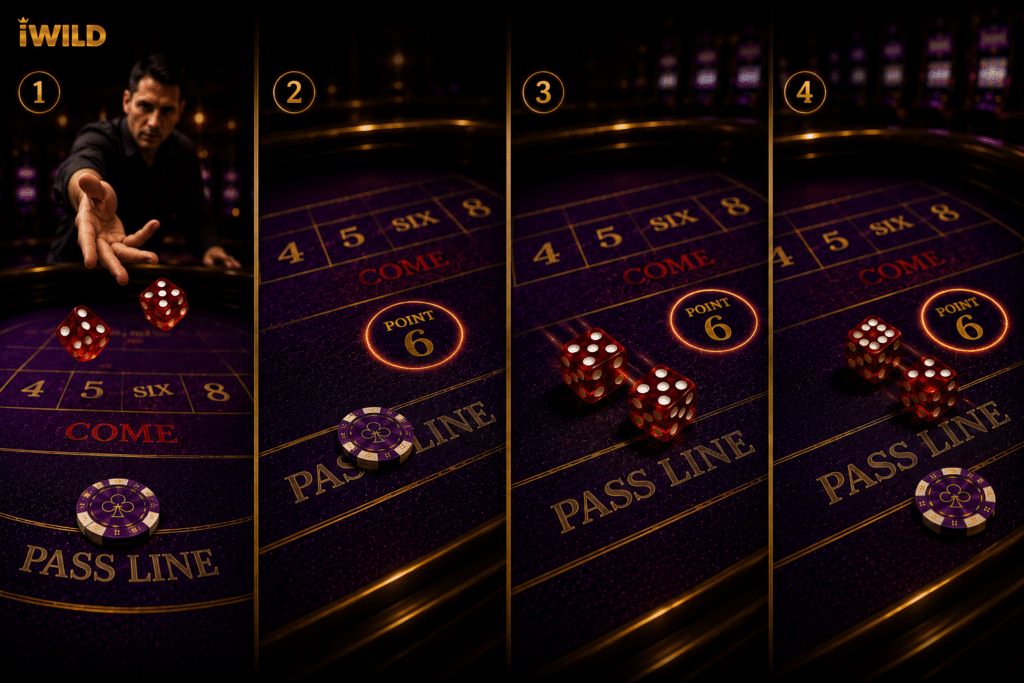
The come-out roll is the first throw of a new Pass Line and Don’t Pass decision. A total of 7 or 11 wins a Pass Line bet immediately, while 2, 3, or 12 loses it. If the shooter rolls 4, 5, 6, 8, 9, or 10, that total becomes the point. The dealer places the marker puck on the matching number and turns it to ON, signaling that the second phase has begun for everyone.
The Point Phase
Once a point exists, the shooter continues rolling. A Pass Line bet wins if the point appears again before 7. It loses if 7 arrives first, which is commonly called sevening out. Making the point ends that decision, but the same shooter normally begins another come-out roll and keeps control of the dice. Sevening out ends the shooter’s turn, after which the dice are offered clockwise to the next willing player at the table.
The Craps Table Layout
A full craps table is long, high-sided, and designed for group play. The main betting layout is mirrored at both ends, so players on either side can reach the Pass Line, Don’t Pass, Come, Don’t Come, and Field areas. Number boxes for 4, 5, 6, 8, 9, and 10 sit nearer the dealers, who handle Place, Buy, Lay, and Come-point wagers. The central proposition area contains bets such as Hardways, Any Seven, Any Craps, Horn, and Hop wagers. A puck marked ON or OFF shows whether a point is active for the current decision and identifies the point number.
How to Play a Round of Craps, Step by Step
The following sequence takes you from approaching a live table to completing a full decision. It brings the come-out roll, point phase, betting areas, and dealer procedures into one practical walkthrough. Venue practices can differ slightly, so listen to the crew and follow the posted minimums, maximums, and table rules.
Step 1: Buy In and Get Chips
Find an open position along the rail and wait until the dice are in the center before buying in. Place cash flat on the layout where the dealer can see it, rather than passing it across moving chips or active wagers. The dealer counts the money, confirms the amount, and exchanges it for value chips. Keep your chips in the rail in front of you and ask about denominations if you are unsure.
Official rules require wagers to be made with value chips or plaques. A dealer may also accept a verbal wager accompanied by cash, provided the amount is confirmed and converted into chips promptly.
Step 2: Place Your Pass Line Bet
Look at the puck. When it shows OFF, the table is ready for a come-out roll. Place a chip on the clearly marked Pass Line before the dice are thrown. This is a simple first wager because its result follows the main game. Check that your chip meets the posted minimum. Once a point is established, the Pass Line bet becomes a contract bet and generally cannot be removed or reduced until the decision ends.
Step 3: The Come-Out Roll
The stickperson offers several dice to the shooter, who selects two. The shooter throws both so they leave the hand together and reach the far end of the table. If the total is 7 or 11, Pass Line bets win. Totals of 2, 3, or 12 lose. A roll of 4, 5, 6, 8, 9, or 10 establishes the point, and the dealer moves the puck to that number with the ON side visible.
Step 4: The Point Phase Begins
With the puck ON, the shooter tries to roll the point again before 7. Additional wagers become available, including Odds behind the Pass Line, Come bets, and Place bets on other numbers. A beginner can ignore most of them and add only an Odds bet after understanding the amount allowed. The crew settles each completed wager after every valid throw, while bets that have not yet reached a decision remain on the layout.
Step 5: The Round Ends
The decision ends when the point repeats or 7 appears first. If the point repeats, Pass Line bets and their Odds win, and the same shooter usually starts a new come-out roll. If 7 appears first, Pass Line bets lose and the shooter’s turn ends. The dice then move to the next willing player.
Core Bets Every Beginner Should Know
The layout offers many choices, but a confident beginner needs only a small group of wagers to understand the game. Start with Pass Line or Don’t Pass, then learn Odds. Come, Don’t Come, and Place bets can wait until the basic come-out and point cycle feels familiar.
Pass Line
The Pass Line is the standard beginner bet. Place it before the come-out roll. It wins immediately on 7 or 11, loses on 2, 3, or 12, and otherwise follows the point until that number or 7 appears. The wager pays even money.
Based on the standard rules and the 36 possible two-dice combinations, its house edge is about 1.41%. That is low compared with most proposition bets and makes it a sensible foundation for learning.
Don’t Pass Line
Don’t Pass is the opposite side of the main decision. On the come-out roll, it wins on 2 or 3, loses on 7 or 11, and normally pushes on 12, meaning the stake is returned. After a point is established, Don’t Pass wins when 7 arrives before the point.
Its calculated house edge is about 1.36%, slightly below Pass Line. Some players avoid it at a lively table because they are betting against the result most others want.
Come and Don’t Come
Come and Don’t Come create new line-bet decisions after the table point is already ON. A Come bet acts like a fresh Pass Line wager: 7 or 11 wins on its first roll, 2, 3, or 12 loses, and another box number becomes its Come point.
Don’t Come mirrors Don’t Pass, including the standard push on 12. These bets let you build action on additional numbers without changing the familiar line-bet rules.
Odds Bets
An Odds bet is an extra wager placed after a Pass, Don’t Pass, Come, or Don’t Come bet has moved to a point. It pays at the true mathematical odds of the point: 2 to 1 on 4 or 10, 3 to 2 on 5 or 9, and 6 to 5 on 6 or 8 for Pass-side Odds.
Because the payout matches the actual probability, the Odds portion has a 0% house edge. The underlying line bet still carries its normal edge, and the table may limit how much Odds you can take or lay.
Place Bets
A Place bet backs one number from 4, 5, 6, 8, 9, or 10 to appear before 7. You can usually make it while a point is active and ask the dealer to remove or reduce it before a deciding roll.
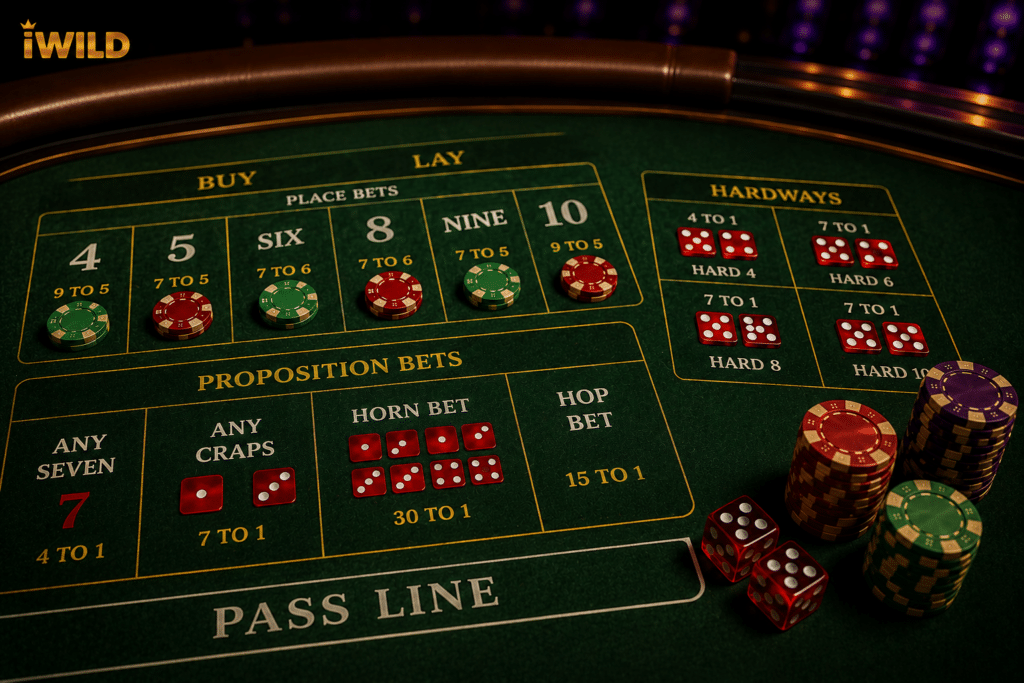
Standard winning payouts are 9 to 5 on 4 or 10, 7 to 5 on 5 or 9, and 7 to 6 on 6 or 8. The 6 and 8 offer the lowest house edge among standard Place bets.
Other Bets You’ll See on the Table
You will also notice several wagers that are not needed for a first session. Knowing what they mean helps you follow the dealer calls and table action, but recognition is enough at this stage. The following bets add commissions, specific dice combinations, or one-roll outcomes that create extra complexity and often higher house edges.
Buy and Lay Bets
Buy and Lay bets use true odds on a selected number, with a commission charged by the casino. A Buy bet wagers that the number will arrive before 7. A Lay bet wins if 7 arrives first.
Commission rules vary. The fee may be collected when the bet is made or only when it wins. Because the calculation is less intuitive than Pass Line and Odds, beginners can leave these wagers until later.
Hardways
A Hardway backs 4, 6, 8, or 10 appearing as matching dice before either 7 or the same total appears another way. Hard 8, for example, requires 4 and 4. It loses if 8 appears as 2 and 6 or 3 and 5, or if 7 comes first.
Standard payouts are 7 to 1 on Hard 4 and 10 and 9 to 1 on Hard 6 and 8. The house edges remain high.
Proposition Bets: Any Seven, Any Craps, Horn, and Hop
Proposition wagers are usually one-roll bets in the center of the layout. Any Seven wins only when the next roll is 7. Any Craps covers 2, 3, or 12. A Horn divides the stake across 2, 3, 11, and 12, while a Hop bet names a particular dice combination.
The dealer or stickperson places these wagers. Their payouts look large because the outcomes are rare, and their house edges are generally much higher than line bets.
The 3-4-5x Odds Rule Explained
If a table posts 3-4-5x Odds, it limits Pass or Come Odds according to the point. You may take up to three times the flat bet on 4 or 10, four times on 5 or 9, and five times on 6 or 8.
Those different multiples create the same maximum Odds profit: six times the original flat bet. For example, a $10 line bet permits $30 on 4 at 2 to 1, $40 on 5 at 3 to 2, or $50 on 6 at 6 to 5. It is one possible limit structure. Other tables may post lower, higher, or uniform Odds multiples. Official rules can permit operators to set and display their own approved limits.
How Multiple Bets Work Together
Experienced players may hold a Pass Line bet with Odds plus several Come bets, each carrying separate Odds on different numbers. Dealers track these positions, which is why the layout can look crowded.
You do not need that complexity immediately. One Pass Line bet and a correctly sized Odds wager provide enough action to learn the calls, puck movement, and settlement process. Add one Come bet later if you want to practice managing another point.
Craps Table Etiquette and Dice Handling
Wait until the dice are in the center before putting cash or late chips onto the layout. Make clear, timely bets and let the dealer place wagers in areas you cannot reach directly. When shooting, use the two selected dice and throw them together so they strike the far end of the table.
A roll can be called invalid if the dice leave the hand separately, fail to reach the far end, leave the table, land on top of each other, or are thrown improperly. Keep hands, drinks, and loose belongings away from the betting surface while the dice are moving. Do not touch another player’s chips.
You may decline the dice when offered, and you can ask the crew for help without apologizing for being new.
Tips for Craps Beginners
A first craps session becomes easier when you reduce the number of decisions. Choose a small betting unit, learn one main wager, and watch how the crew controls the pace. The habits below help you stay organized, avoid rushed choices, and understand what is happening before adding more chips or unfamiliar bets.
Start With Pass Line and Odds
Begin with the Pass Line because its win and loss conditions match the table’s central story. When a point is established, add Odds only at an amount your bankroll can comfortably support. This pairing keeps the rules simple and directs more of your money toward the only wager paid at true odds.
Avoid Proposition Bets at First
Ignore the bright center-table wagers at first. Any Seven, Any Craps, Horn, Hop, and Hardway bets may create dramatic payouts, but they win less often and generally carry much higher house edges. Learning them is useful. Making them part of your first bankroll is not necessary.
Watch a Few Rounds Before Playing
Stand back for several decisions before buying in. Watch when the puck changes, how players place line bets, and when the dealers accept cash or Odds. Listening to the calls for a few minutes gives the table a recognizable rhythm and reduces the pressure to act while the dice are moving.
Are Betting Systems Worth Using in Craps?
Betting systems change stake sizes after wins or losses, but they do not alter the probability or house edge of the underlying wager. Each valid dice roll is a new event. A progression can impose structure, yet it may also increase stakes quickly during an unfavorable sequence.
Better fundamentals come from choosing lower-edge bets, setting a fixed loss limit, and refusing to chase results. Pass, Don’t Pass, Come, Don’t Come, and true Odds remain stronger than progressions applied to weak bets.
Why the Shooter Does Not Choose What They Roll, and Other Beginner Confusions
The shooter does not choose the total. They select two dice and make a valid throw, but the result still comes from the dice outcome, not from wanting a number or following a betting pattern. Dealers routinely guide nervous first-time shooters, so there is no need to perform elaborate rituals or throw with theatrical force.
You may also decline to shoot when the dice reach you. Simply tell the stickperson, and the dice will be offered to the next player. The cheering makes more sense once you notice that many people hold Pass Line or Come bets and therefore want the shooter to succeed. Don’t Pass players are not breaking a rule. They have simply taken the opposite side.
Finally, making the point does not end the shooter’s turn. It starts a new come-out decision with the same shooter unless they choose to pass the dice. Only a losing 7 requires the shooter to surrender them under the standard rules.
Frequently asked questions
The Pass Line is the best first bet for most beginners. Its rules follow the main flow of the table, it pays even money, and its house edge is about 1.41%. Once a point is set, consider adding an affordable true Odds wager.
Snake eyes, a total of 2, is bad for Pass Line bets on the come-out roll because they lose immediately. It is good for a standard Don’t Pass bet, which wins on 2. Other wagers on the layout may settle differently.
To seven out means rolling 7 after a point has been established and before that point repeats. The result loses Pass Line bets, wins Don’t Pass bets, ends the current shooter’s turn, and returns the puck to OFF for a new shooter.
Yes. Odds wagers pay according to the true probability of the point, so the Odds portion itself has a 0% house edge. You must first have a Pass, Don’t Pass, Come, or Don’t Come bet, which retains its own house edge.
Yes. You can begin with only the Pass Line rules and ask the dealer where to place a chip or an Odds wager. Wait until the dice are in the center, speak clearly, and avoid making several unfamiliar bets at once.

