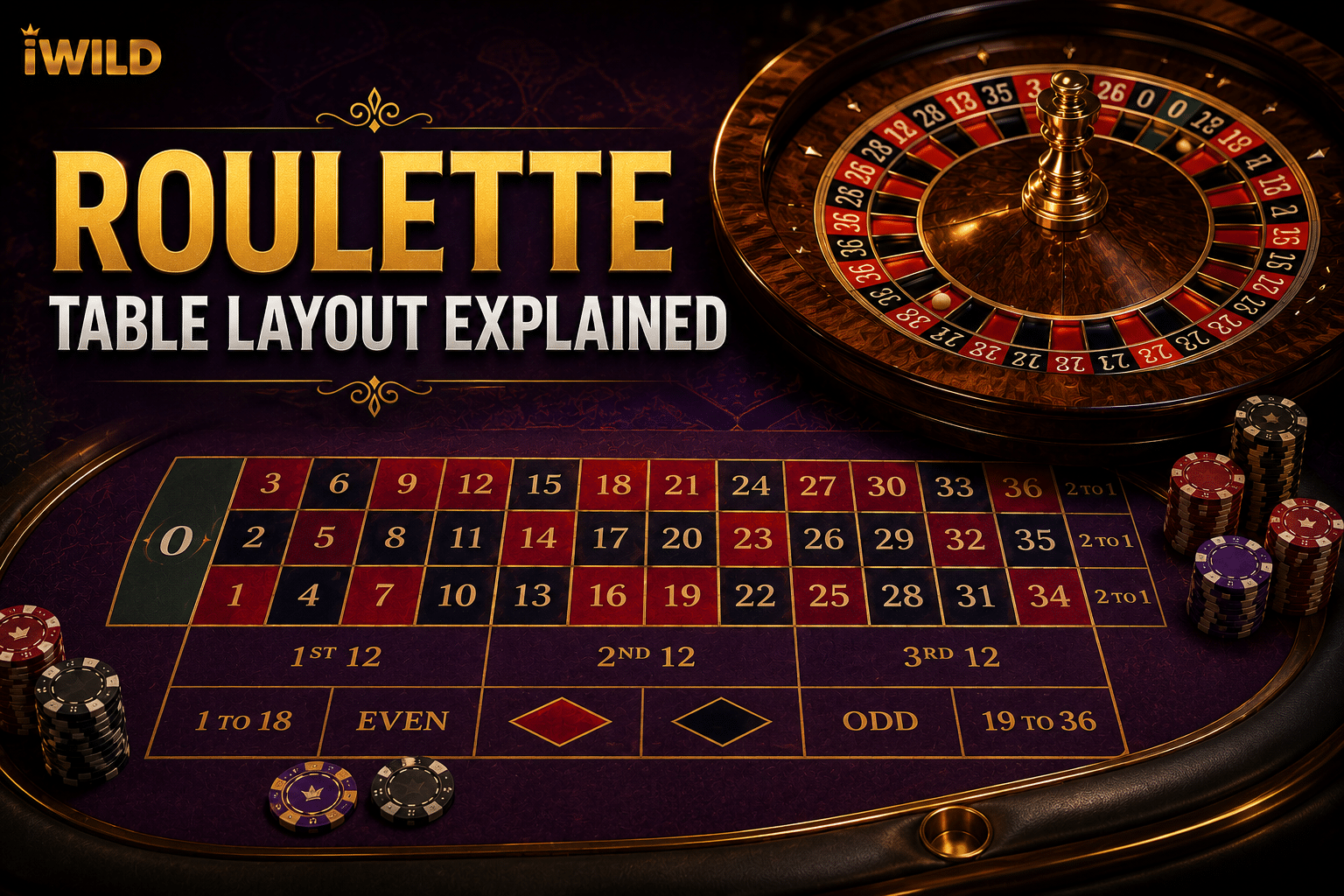
A roulette table layout has two separate parts. The spinning wheel uses a fixed number sequence designed around the wheel’s physical structure, while the flat betting grid places numbers 1 to 36 in simple numerical order.
The two arrangements do not match. This guide explains both layouts, why the wheel numbers are positioned as they are, how to place each main bet, and how European, American, and French tables differ.
How Many Numbers Are on a Roulette Table?
The answer depends on the roulette variant. A European or French wheel has 37 pockets, covering numbers 1 to 36 and one green zero. An American wheel adds 00, creating 38 pockets. Triple-zero roulette adds a third green pocket for 39.
The standard payouts do not increase when another zero is added. Each extra green pocket therefore raises the house edge by creating another losing result for red or black, odd or even, and high or low bets.
| Variant | Total Pockets | Zeros | House Edge Impact |
| European, single zero | 37 | 0 | Standard house edge of 2.70% |
| American, double zero | 38 | 0 and 00 | House edge rises to 5.26% |
| Triple zero | 39 | 0, 00, and 000 | House edge rises to 7.69% |
The Roulette Wheel Number Sequence and Why It Is Arranged That Way
The numbers around a roulette wheel do not follow numerical order. At first glance, their positions can look random. In reality, a standard wheel uses a fixed sequence that spreads different colors and numerical categories around the full circle. European and American wheels use completely different arrangements.
European Wheel Sequence, Clockwise
A standard European wheel contains one zero and 36 numbered pockets. Beginning with zero and moving clockwise, the sequence is:
0, 32, 15, 19, 4, 21, 2, 25, 17, 34, 6, 27, 13, 36, 11, 30, 8, 23, 10, 5, 24, 16, 33, 1, 20, 14, 31, 9, 22, 18, 29, 7, 28, 12, 35, 3, 26
The same single-zero arrangement supports traditional racetrack, neighbor, and wheel-sector bets.
American Wheel Sequence, Clockwise
American roulette has its own fixed sequence rather than adding 00 to the European order. Starting at zero and moving clockwise, the sequence is:
0, 28, 9, 26, 30, 11, 7, 20, 32, 17, 5, 22, 34, 15, 3, 24, 36, 13, 1, 00, 27, 10, 25, 29, 12, 8, 19, 31, 18, 6, 21, 33, 16, 4, 23, 35, 14, 2
The 00 pocket is positioned opposite 0, dividing the wheel into two broad halves.
Why the Numbers Are Balanced, Not Random
The wheel sequence mixes red and black pockets around the circle. It also disperses odd and even numbers, plus low numbers from 1 to 18 and high numbers from 19 to 36.
The arrangement is not a perfect alternation across every category. Occasional neighboring pockets share the same color classification, parity, or range.
This balance makes the wheel visually varied and prevents one category from being concentrated in a single section. It does not change the probability of an individual pocket on a properly functioning wheel.
Each pocket remains one possible result, and previous spins do not alter the next outcome. The sequence is carefully structured, but it does not provide a predictive pattern.
How to Read the Betting Table
The betting grid, sometimes called the felt or layout, is organized for quick chip placement. It does not copy the sequence around the wheel. Numbers 1 to 36 appear in ascending order, divided into three columns and 12 horizontal rows. The zero area sits at one end.
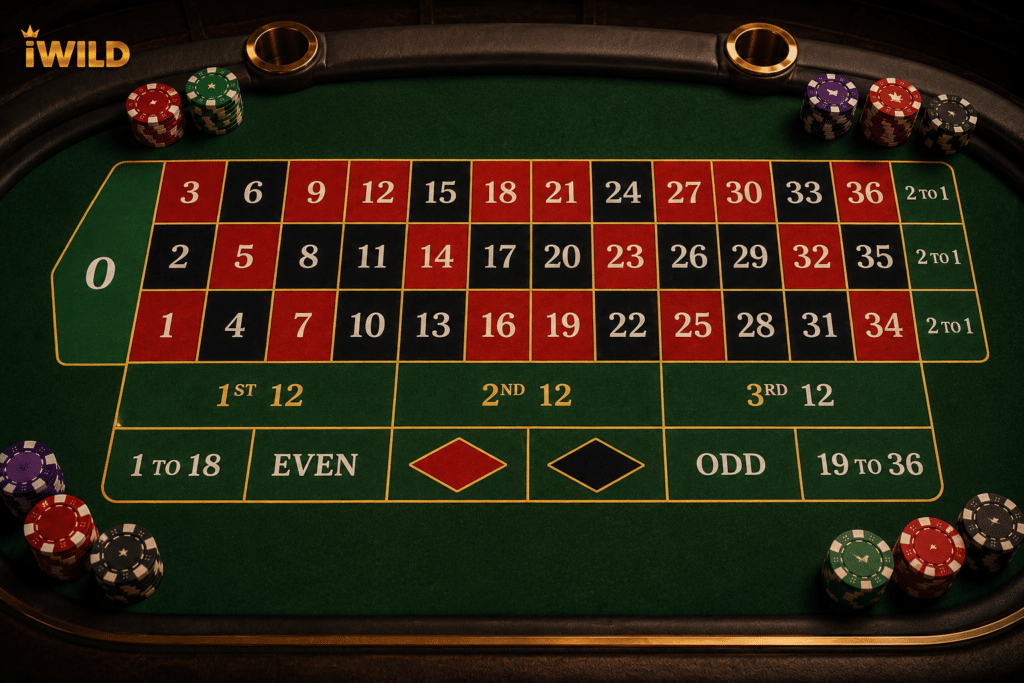
Table Boxes
The central grid contains numbered boxes for 1 to 36, arranged in rows of three. On a single-zero layout, one green 0 box sits beside the first row. An American table also includes 00.
Wagers placed within numbered boxes or on the lines and intersections around them are inside bets. These include straight-up, split, street, corner, and six-line wagers. They cover relatively few outcomes and offer larger payouts than bets covering broad groups of numbers.
Table Columns
Three column boxes sit at the end of the numbered grid. Each covers 12 numbers running through one vertical line. The dozen areas cover 1 to 12, 13 to 24, or 25 to 36.
The wider outside area also contains red and black, odd and even, and low and high boxes. These wagers cover 18 numbers and pay even money. Their larger coverage makes the layout easier to read for someone learning roulette, although zero is not included in any of them.
The Three Main Wheel Variants
Most roulette tables fall into one of three recognizable formats. European and French roulette use a single-zero wheel, while American roulette adds 00. French roulette differs mainly through its table presentation and special rules rather than a separate wheel sequence.
European: Single Zero
European roulette uses 37 pockets, consisting of numbers 1 through 36 and one green zero. Standard straight-up bets pay 35 to 1, while other payouts follow the number of pockets covered.
With only one green pocket, the standard house edge is approximately 2.70%. This makes the European layout more favorable than American or triple-zero roulette when standard payouts are used. Single-zero roulette is also the format associated with racetrack and traditional wheel-sector selections.
American: Double Zero
American roulette contains 38 pockets, including both 0 and 00. The two green pockets are positioned opposite each other on the wheel, while the numbered pockets follow a sequence distinct from European roulette.
The table adds a 00 box beside zero and normally offers a five-number bet covering 0, 00, 1, 2, and 3. Because payouts remain based on the traditional roulette schedule, the second zero raises the standard house edge to approximately 5.26%.
French: Single Zero With La Partage or En Prison
French roulette uses the same 37-pocket wheel structure as European roulette. Its physical table may be longer, with French names such as Rouge, Noir, Pair, Impair, Manque, and Passe printed on the layout.
The key difference is the treatment of even-money wagers when zero lands. Under La Partage, half the stake is returned. Some French tables instead use En Prison, which holds the wager for another spin. Always check which rule the specific table applies.
House Edge by Table Variant
The number of green pockets is the main structural factor behind roulette’s house edge. A single-zero table offers 37 possible outcomes while a straight-up win still pays 35 to 1. Adding 00 or 000 creates more losing outcomes without raising the standard payout.
French rules can lower the edge on even-money wagers when zero appears.
| Variant | House Edge | Why |
| European | 2.70% | One zero among 37 pockets |
| American | 5.26% | Two zeros among 38 pockets |
| French | 1.35% on qualifying even-money bets with La Partage | Half the stake is returned when zero lands |
Sectors and Neighbor Bets: Reading the Wheel, Not Just the Felt
Sector bets group numbers according to their physical position around a European wheel. They are different from dozens, columns, streets, or corners, which are defined by the flat betting grid.
A neighbor bet covers one selected number and nearby pockets on either side. Sector wagers cover fixed arcs of the wheel using several straight-up and split bets. Online roulette interfaces often display these selections through a racetrack graphic beside the main grid.
| Sector | Numbers Included |
| Voisins du Zéro (Neighbours of Zero) | 22, 18, 29, 7, 28, 12, 35, 3, 26, 0, 32, 15, 19, 4, 21, 2, 25 |
| Jeu Zéro (The Zero Game) | 12, 35, 3, 26, 0, 32, 15 |
| Tiers du Cylindre (Third of the Wheel) | 27, 13, 36, 11, 30, 8, 23, 10, 5, 24, 16, 33 |
| Orphelins (The Orphans) | 1, 20, 14, 31, 9, 17, 34, 6 |
Bet Types and Where They Sit on the Layout
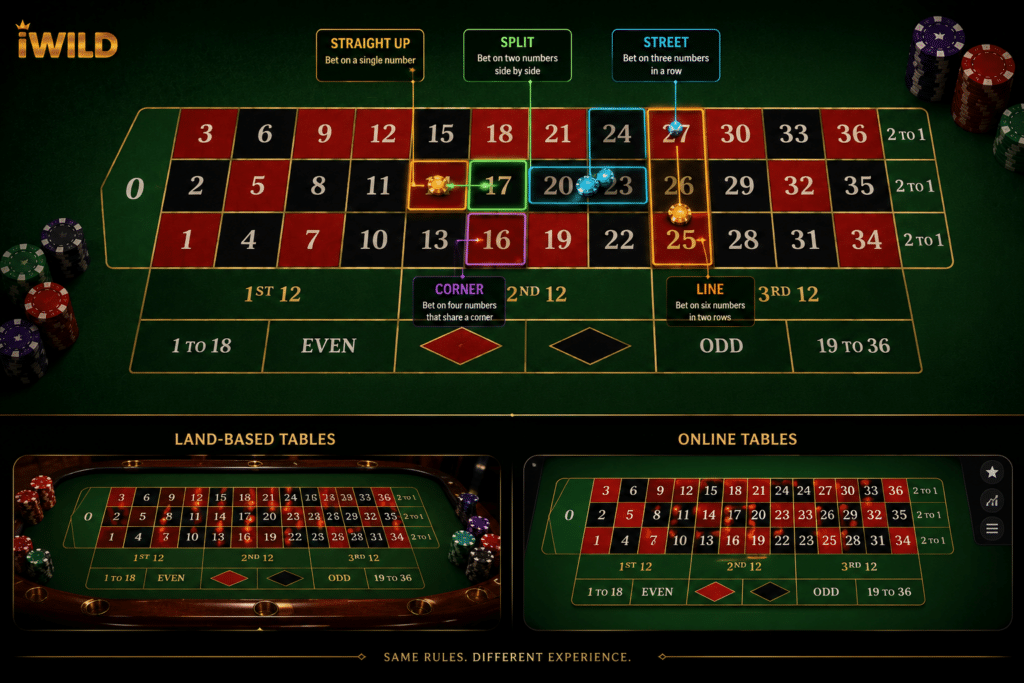
Inside bets occupy the numbered grid. A straight-up chip sits inside one box. A split sits on the line between two neighboring boxes. A street is placed at the outside edge of one three-number row. A corner sits where four boxes meet. A six-line wager sits where two rows meet.
Outside bets surround the main grid. Dozens appear beside the 12-number groups, while columns sit at the end of the three vertical lines. Red or black, odd or even, and 1 to 18 or 19 to 36 occupy the wider outside section. Placement determines exactly which numbers the chip covers.
Land-Based vs. Online Table Layouts
A land-based roulette table uses physical chips and a shared felt managed by a dealer. Players may place their own chips or ask the dealer to help position announced bets.
Online RNG and live-dealer tables use a digital grid. The interface can add repeat-bet buttons, statistics, favorite selections, racetrack controls, and neighbor shortcuts. Despite those visual tools, the underlying chip positions still represent the same straight-up, split, street, corner, six-line, dozen, column, and even-money wagers.
Why the Betting Grid and the Wheel Do Not Match: The Most Common Layout Misconception
The betting grid uses numerical order because that is the simplest way to organize dozens of possible wagers. The wheel uses a completely different sequence designed around physical pockets.
As a result, two numbers next to each other on the felt may be far apart on the wheel. For example, 17 and 18 touch on the grid, but they sit in different wheel sectors. Conversely, two numbers that look unrelated on the grid can be physical neighbors around the wheel.
This distinction explains why grid bets and sector bets are separate concepts. A street, corner, dozen, or column is based on chip position on the felt. Voisins du Zéro, Tiers du Cylindre, Orphelins, Jeu Zéro, and neighbor selections are based on the circular sequence.
Understanding this difference is essential before using a racetrack interface. The grid tells you where to place a standard bet. The wheel sequence tells you which physical area a sector wager covers.
Frequently asked questions
A European or French roulette wheel has 37 pockets, covering 1 to 36 plus zero. An American wheel has 38 because it adds 00. A triple-zero wheel has 39 pockets, including 0, 00, and 000.
No. European and American wheels use two separate fixed sequences. American roulette does not simply insert 00 into the European arrangement. Triple-zero layouts can also use their own approved wheel configuration, so check the table or game rules.
There is no simple counting pattern. The wheel disperses colors, odd and even numbers, and high and low values around the circle. This balanced arrangement does not predict results, since each valid spin remains independent.
A European wheel has 37 pockets, so no pocket sits perfectly opposite zero. Numbers 5 and 10 lie closest to the opposite point. On a standard American wheel, the 00 pocket is positioned directly opposite 0.
It does not create a mathematical advantage or predict where the ball will land. Memorizing the sequence can, however, help you recognize neighboring pockets and place sector or racetrack wagers more quickly.

