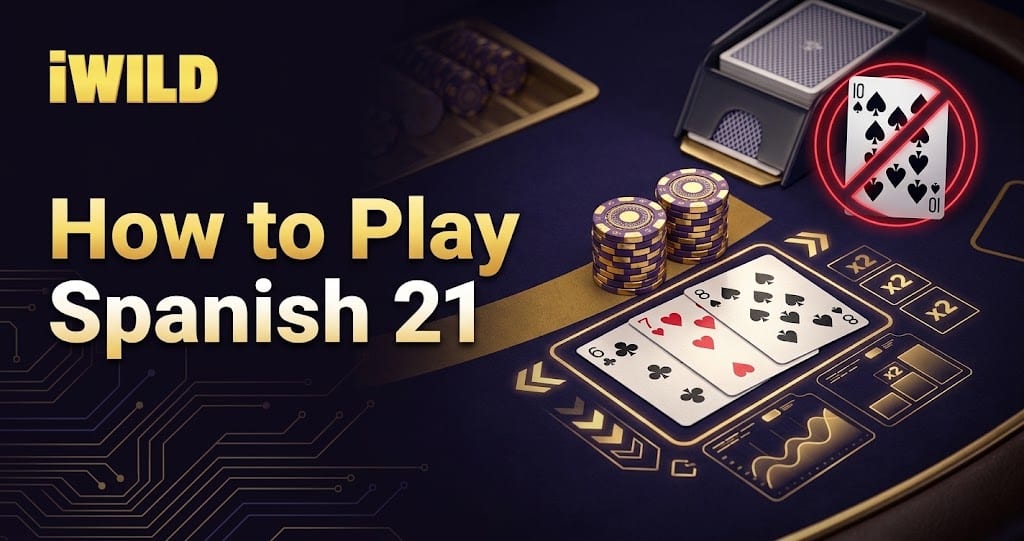
Learning how to play Spanish 21 starts with understanding what happens when the numbered 10s disappear from a blackjack deck. The game looks familiar, but its card composition, bonus payouts, and additional betting options change how you should approach each hand.
If you’re exploring iWild Casino online, this guide explains the rules of Spanish 21, how to read your cards, which decisions you can make, and what bonus combinations mean. You’ll also find verified casino payout examples and a breakdown of how different rules affect the odds.
What You’re Actually Playing in Spanish 21
Spanish 21 is a blackjack variation in which you compete against the dealer to make a stronger hand without exceeding 21.
You receive two cards, evaluate their total, and decide whether to hit, stand, double, split, or surrender when permitted. The dealer then completes their hand according to the table’s rules.
The main difference is that Spanish 21 removes all four numbered 10s from each deck while retaining Jacks, Queens, and Kings.
It compensates with additional player options and bonus payouts for certain hands.
These built-in rewards are separate from casino promotions for players.
Reading the Spanish 21 Deck

A Spanish 21 deck contains 48 cards instead of the usual 52. Removing the four numbered 10s changes the frequency of different card values.
Card values remain straightforward:
- Cards 2 through 9 count at face value.
- Jacks, Queens, and Kings count as 10.
- Aces count as 1 or 11, whichever benefits the hand.
For example, an Ace and a 6 form soft 17 because the Ace counts as 11. Draw an 8, and the Ace changes to 1, leaving you with 15 instead of busting.
The missing 10s affect the probabilities behind every hit, double, and dealer outcome.
Winning a Hand: The Spanish 21 Objective
Your goal is to finish closer to 21 than the dealer without going over.
A hand can produce three basic outcomes:
- Win: Your 20 beats the dealer’s 18.
- Lose: Your 17 loses against the dealer’s 19.
- Push: Equal qualifying totals return your original wager where the rules permit ties.
Spanish 21 adds special settlement rules for player totals of 21. For example, Ocean Casino Resort states that a player’s 21 beats a dealer’s 21.
If you’d rather examine other formats afterward, browse the casino game selection.
Each Step of a Spanish 21 Round
A Spanish 21 round follows a recognizable sequence:
- Place your wager. Choose an amount within the table’s posted limits.
- Receive your cards. You and the dealer receive initial cards, including the dealer’s exposed upcard.
- Evaluate your hand. Compare your total with the dealer’s visible card.
- Choose your action. Hit, stand, split, double, or surrender when the rules allow.
- Complete the dealer’s hand. The dealer follows the table’s drawing rules.
- Settle the result. Winning hands receive the applicable standard or bonus payout.
You control your playing decisions, not which cards appear.
The live casino lobby can help you become familiar with dealer-led table-game procedures.
What You Can Do on Your Turn
Spanish 21 provides several familiar actions with additional flexibility:
- Hit: Request another card.
- Stand: Keep your current total.
- Double Down: Increase your wager and receive another card.
- Split: Divide eligible matching cards into separate hands.
- Surrender: End an eligible hand by forfeiting part of your wager.
- Double Down Rescue: Withdraw part of a doubled wager after receiving an unfavorable, non-busting card.
Some tables also allow doubling after receiving more than two cards.
Ask the dealer about splitting Aces, doubling restrictions, and surrender before starting.
Reading a Spanish 21 Bonus Payout Table
Spanish 21 awards additional payouts for certain combinations totaling 21. Unlike an optional side bet, these bonuses are normally part of the main game’s payout structure.
Read the table by checking the qualifying hand, payout ratio, and any suit restrictions.
For example, 6-7-8 with mixed suits is treated differently from three cards of the same suit.
The verified schedule below comes from Northern Quest Resort & Casino’s published Spanish 21 gaming guide. Other casinos may use different rules.
Like the slots library, Spanish 21 uses paytables to explain which outcomes receive special rewards.
| Bonus Hand | Pays | Notes |
| 5-card 21 | 3 to 2 | Five cards totaling 21 |
| 6-card 21 | 2 to 1 | Six cards totaling 21 |
| 7+ card 21 | 3 to 1 | Seven or more cards totaling 21 |
| 6-7-8 mixed suits | 3 to 2 | Cards have mixed suits |
| 6-7-8 suited | 2 to 1 | All three cards share a suit |
| 6-7-8 spades | 3 to 1 | All three cards are spades |
| 7-7-7 mixed suits | 3 to 2 | Three 7s with mixed suits |
| 7-7-7 suited | 2 to 1 | All three 7s share a suit |
| 7-7-7 spades | 3 to 1 | Three 7s of spades |
These payouts are not normally available on doubled hands. Review the table’s specific rules for split hands and other restrictions.
Super Bonus Mechanics
The Super Bonus rewards a particularly rare combination involving three suited 7s and the dealer’s exposed card.
For example, imagine receiving three 7s of hearts while the dealer shows a 7 of clubs. Under Northern Quest’s published rules, this qualifies for the Super Bonus because your three 7s share a suit and the dealer’s upcard is also a 7.
The award depends on the qualifying wager level.
Splitting or doubling can make a hand ineligible, so review these restrictions before trying to complete the combination.
Envy Bonus Mechanics
The Envy Bonus rewards other eligible players when someone at their table receives a qualifying Super Bonus.
Imagine four people playing. One player completes the required suited 7-7-7 combination against a dealer 7.
That player receives the Super Bonus. The other three participating players can receive the separate Envy Bonus under the casino’s rules.
Spanish 21 Rule Changes in Three Groups
Spanish 21’s differences from traditional blackjack fall into three practical groups:
- Winning-hand rules: How natural blackjack and totals of 21 are settled.
- Betting decisions: Splitting, doubling, and rescuing doubled wagers.
- Early exits: Surrendering before completing a hand.
Understanding them in this order follows how they affect the game, from determining the strongest result to deciding whether to continue playing.
Winning Hands: Blackjack and 21 Rules
At Ocean Casino Resort and Northern Quest, a player’s natural blackjack beats the dealer’s natural blackjack and receives a 3-to-2 payout.
Both casinos also state that player totals of 21 beat dealer totals of 21.
However, not every casino describes this rule identically. Mohegan Sun’s guide excludes a multi-card player 21 when the dealer has natural blackjack.
That distinction matters because a hand that wins under one rule set may lose under another.
Always check how the casino settles natural blackjack and multi-card 21.
Betting Moves: Splitting, Doubling, Rescue
Splitting divides an eligible pair into two separate hands. Doubling increases the wager on a hand, while Double Down Rescue allows you to withdraw the doubled portion after receiving a non-busting card.
For example:
- You start with a wager of 10 units.
- Your first two cards total 11.
- You double, adding another 10 units.
- Your next card is a 5, leaving you with 16.
- You choose Rescue, forfeiting the original 10 units and recovering the additional 10.
Rescue prevents further exposure on that hand, but it does not recover the original wager. The exact restrictions depend on the casino.
Getting Out Early: Surrender
Surrender allows you to end an eligible hand before normal settlement.
Under Ocean Casino Resort’s published rules, surrendering after the first two cards forfeits half the original wager.
This can be useful when continuing has a worse expected outcome than accepting the partial loss.
However, surrender rules differ. Some casinos allow only late surrender, while others impose additional restrictions if the dealer has natural blackjack.
Match the Dealer: Bet Mechanics
Match the Dealer is an optional side bet based on whether either of your first two cards matches the dealer’s exposed card.
A non-suited match means the rank matches but the suit differs. A suited match requires both rank and suit to match.
For example, suppose the dealer shows the 8 of hearts. Your initial cards are the 8 of hearts and 8 of clubs.
You have one suited match and one non-suited match.
Some casinos also provide separate Match the Dealer options involving the dealer’s hidden card.
Payout Structure of the Side Bet
Match the Dealer payouts increase when matching combinations become less common.
A single non-suited match generally pays less than a suited match. Two suited matches usually receive the largest standard payout because they are especially rare.
The following table uses Ocean Casino Resort’s published Spanish 21 Match the Dealer schedule, not a universal payout structure.
| Match Type | Pays | Casino Source |
| 1 non-suited match | 3 to 1 | Ocean Casino Resort |
| 2 non-suited matches | 6 to 1 | Ocean Casino Resort |
| 1 suited match | 12 to 1 | Ocean Casino Resort |
| 1 non-suited and 1 suited match | 15 to 1 | Ocean Casino Resort |
| 2 suited matches | 24 to 1 | Ocean Casino Resort |
These are separate side-bet payouts. A winning main hand does not automatically make the Match the Dealer wager a winner.
From Strategy to Manners: Table Know-How
Before joining a Spanish 21 table, inspect its rules rather than assuming standard blackjack strategy will work.
Removing the numbered 10s changes the probability of drawing a 10-value card. Spanish 21 also rewards specific multi-card combinations and offers decisions that ordinary blackjack may not.
A useful preparation routine includes:
- Check whether the dealer hits or stands on soft 17.
- Learn the casino’s Spanish 21 basic strategy for its particular rules.
- Review the splitting, doubling, surrender, and Rescue options.
- Read bonus conditions before making additional wagers.
- Set a spending limit and choose stakes that fit it.
Once seated, wait until betting is open before placing chips. Keep your hands away from active cards and wagers unless the dealer requests otherwise.
Use clear verbal instructions when needed, particularly for surrender or unfamiliar actions.
If you’re new to casino table procedures, learning how to play craps can also introduce useful habits around dealer instructions, wager placement, and table etiquette.
Reading Your Casino’s Spanish 21 Rule Sheet

Start with the number of decks and whether the dealer hits soft 17. Then review natural blackjack, multi-card 21, doubling, splitting, surrender, and bonus payouts.
Finally, examine optional side bets and their limits.
The published rules below demonstrate why you should not rely on one casino’s paytable when visiting another.
For example, Northern Quest’s Match the Dealer payouts differ from Ocean’s. Mohegan Sun also describes a more restrictive settlement rule for a multi-card 21 against dealer blackjack.
| Rule | Ocean Casino Resort | Northern Quest Resort & Casino | Mohegan Sun |
| Match the Dealer payouts | 3:1, 6:1, 12:1, 15:1, 24:1 | 4:1, 8:1, 9:1, 13:1, 18:1 | 3:1, 6:1, 12:1, 15:1, 24:1 |
| Match the Dealer bet limits | 1 minimum, 100 maximum | 1 minimum, 100 maximum | Not specified in published guide |
| Double Down Rescue offered | Yes | Yes | Yes |
| Insurance offered | Not specified on Spanish 21 page | Yes | Insurance described in general blackjack guide; confirm for Spanish 21 |
| Surrender terms | First two cards, half wager forfeited | Late surrender | First two cards; full wager lost against dealer blackjack |
| Bonus payout differences | Suited 6-7-8 listed at 3:1 without a separate spades row | Suited 6-7-8 pays 2:1; spades pay 3:1 | Suited 6-7-8 pays 2:1; spades pay 3:1 |
Published betting-limit figures are shown without currency notation to keep this educational guide currency-neutral. Check the denomination and current limits at the actual table. Ocean’s suited 6-7-8 listing should also be clarified with the dealer because it differs from the other published schedules.
Odds and Edge: Spanish 21 Beside Blackjack
Spanish 21 removes valuable numbered 10s, which disadvantages the player compared with an otherwise identical blackjack deck.
However, favorable rules, additional playing options, and bonus payouts can offset much of that disadvantage.
Mathematician Michael Shackleford’s Wizard of Odds analysis shows how strongly Spanish 21’s house edge depends on whether the dealer hits soft 17 and whether redoubling is permitted.
The figures below assume appropriate basic strategy. Spanish 21 figures exclude the additional effect of the Super Bonus.
Understanding such differences also helps when examining other games, including bubble craps strategy.
| Game | Rule Set Assumed | House Edge | Source |
| Spanish 21 | Dealer stands on soft 17 | 0.40% | Wizard of Odds |
| Spanish 21 (alternate rule set) | Dealer hits soft 17; no redoubling | 0.76% | Wizard of Odds |
| Standard blackjack | Atlantic City rules: dealer stands on soft 17, double after split permitted, up to four hands | 0.43% | Wizard of Odds |
These are examples under different specified rule sets, not guaranteed results for a particular casino. Side bets carry their own house edges.
Still Wondering? Spanish 21 Answers
Splitting depends on your pair, the dealer’s exposed card, and the table’s rules. Aces and 8s are common splitting candidates, but Spanish 21 requires its own strategy. Check how many splits are allowed and whether you can draw additional cards to split Aces.
Understand the missing numbered 10s, card values, and how your casino settles player totals of 21. Review the splitting, doubling, surrender, and Rescue rules. Learning the table’s bonus payouts beforehand will also help you recognize special winning combinations.
Eligible five-card, six-card, and seven-or-more-card hands totaling 21 can receive bonus payouts. Certain 6-7-8 and 7-7-7 combinations also qualify. Suited and all-spade versions may receive additional rewards, depending on the casino’s published rules and applicable restrictions.
Mental card counting is generally not itself illegal, but casinos may restrict or refuse service to players they identify as advantage players. Laws differ by jurisdiction. Because Spanish 21 removes numbered 10s, conventional blackjack counting systems need adjustments and may perform differently.
All four numbered 10s are removed from each deck. Jacks, Queens, and Kings remain and still count as 10. Spanish 21 commonly uses six or eight 48-card decks, although the number depends on the table. Checking the deck count is part of learning how to play Spanish 21 correctly.